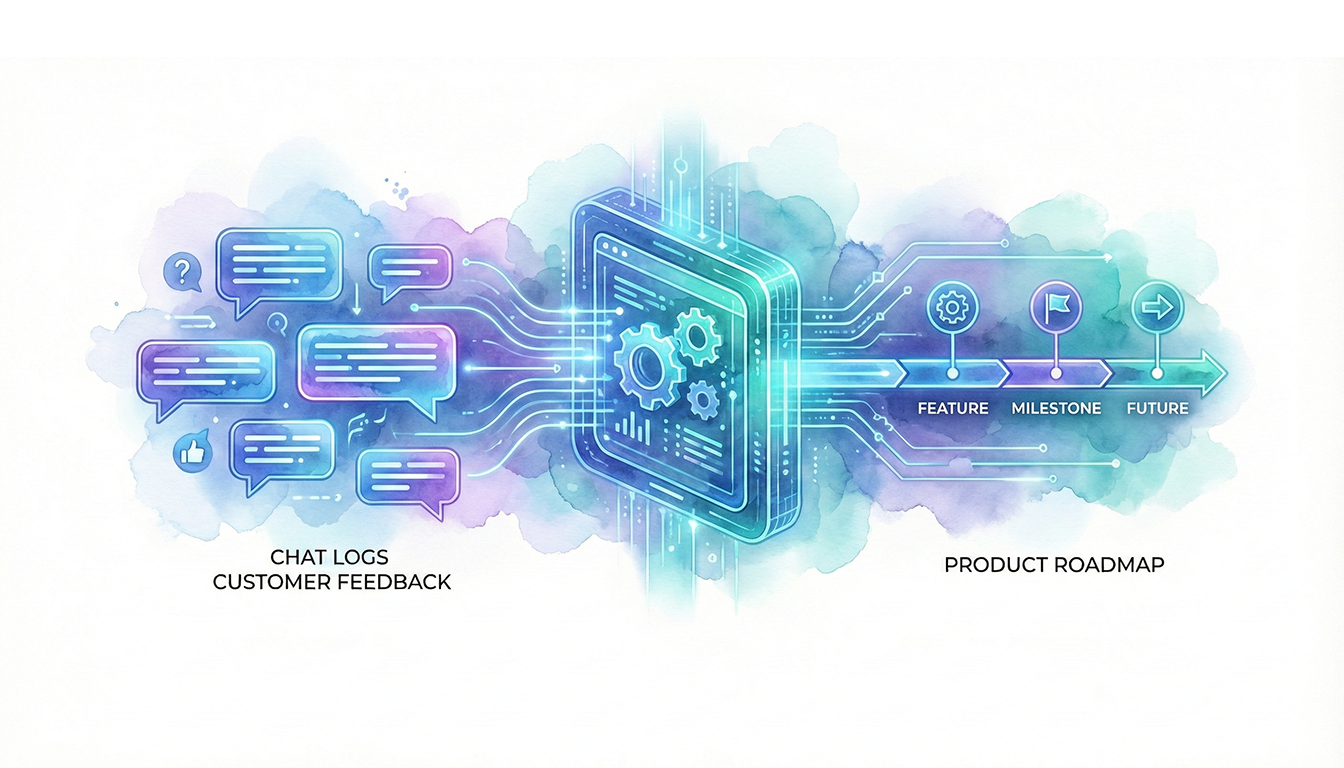
For product managers, customer feedback is the lifeblood of innovation. Yet, the process of collecting and acting on it is often broken. Feedback arrives in disconnected silos—support tickets, survey results, social media mentions—each providing a tiny, context-free snapshot of a much larger picture. The result? Product roadmaps become a list of feature requests rather than a strategic plan to solve real customer problems.
What if you could tap into a continuous, contextual stream of your users’ thoughts, needs, and frustrations, expressed in their own words? This is the strategic advantage of analyzing the data from your Sideconvo AI assistant. The on-page conversations your users are having with your AI are a goldmine of qualitative data, offering direct insights into their journey.
Here’s a practical, four-step framework for turning those conversation logs into a powerful, customer-driven product roadmap.
Step 1: Monitor Conversations to Find Content Gaps
The most immediate and actionable insight from your chat logs is identifying what your users are asking for that your website doesn’t currently answer. The Sideconvo dashboard allows you to easily sift through user interactions and see what they’re asking. Every question that the AI struggles with, or that reveals a topic you haven’t covered, is a gift: it’s a user explicitly telling you what information is missing from your website.19
By regularly reviewing these conversations, you can quickly spot recurring themes. This creates a data-driven priority list for your content team. If ten people asked about a specific integration this week, you know exactly what your next help article or FAQ page should be about.
Step 2: Spot Recurring Questions to Find Friction Points
Even when your AI provides a correct answer, the questions themselves are incredibly valuable. Are dozens of users asking “Where do I find my invoice?” on their account dashboard? That’s a clear signal that your UI/UX for invoicing is not intuitive.
Analyzing the most frequently asked questions on specific pages of your site allows you to diagnose points of friction in the user journey. These insights go beyond what traditional analytics can tell you. You don’t just know that users are dropping off on a certain page; you know why. This allows you to make targeted improvements to your website’s design and copy to proactively address user confusion.
Step 3: Update the Knowledge Base Instantly
Once you’ve identified a content gap or a point of confusion, Sideconvo’s dashboard gives you the power to fix it immediately. You don’t have to wait for a full website redesign. You can:
- Upload New Knowledge: Instantly expand what your AI knows by uploading PDFs, slide decks (PPTX), and Word documents (DOCX) directly to the knowledge base.
- Recrawl a Page: If you’ve updated a page on your site with new information, a single click tells Sideconvo to recrawl it and update its knowledge base with the latest content.
- Manually Add URLs: If you’ve created a new blog post or help doc to address a common question, you can add the URL directly to the knowledge base.
- Edit Content Manually: For fine-tuning, you can even edit the markdown content for a specific URL directly within the dashboard, ensuring the AI has the perfect answer without changing your live site.
Step 4: Uncover Unmet Needs to Drive Innovation
Users will inevitably ask your AI assistant about features or capabilities your product doesn’t have yet. “Can I export this to PDF?” or “Do you integrate with Salesforce?” These aren’t just support queries; they are unsolicited feature requests.
Tracking these questions provides a powerful, data-driven signal for your product roadmap. Instead of relying on anecdotal evidence from a few sales calls, you can quantify the demand for new features based on hundreds or thousands of user interactions. This allows you to prioritize your roadmap based on what a broad segment of your users are actively asking for, ensuring you build what truly matters.
Conclusion
Stop treating customer feedback as a disconnected series of complaints and requests. By leveraging the rich, contextual conversations happening with your Sideconvo AI, you can transform your feedback process from a passive data-collection exercise into a dynamic engine for customer-centric growth.
This approach allows you to build a product roadmap that reflects the genuine needs of your customers, ensuring that every feature you ship delivers real, tangible value and strengthens your relationship with the users who matter most.
Ready to build a roadmap your customers will love? See how Sideconvo can transform your product development process.